Kubota PAD4.0
A service parts catalog system for agricultural machinery, construction machinery, and engines globally distributed by Kubota Corporation.


A service parts catalog system for agricultural machinery, construction machinery, and engines globally distributed by Kubota Corporation.
This solution was developed by the Fenrir Japan team, a member of the Fenrir Group. This example is intended to demonstrate Fenrir’s design and development capabilities, and is not a product of Fenrir North America.
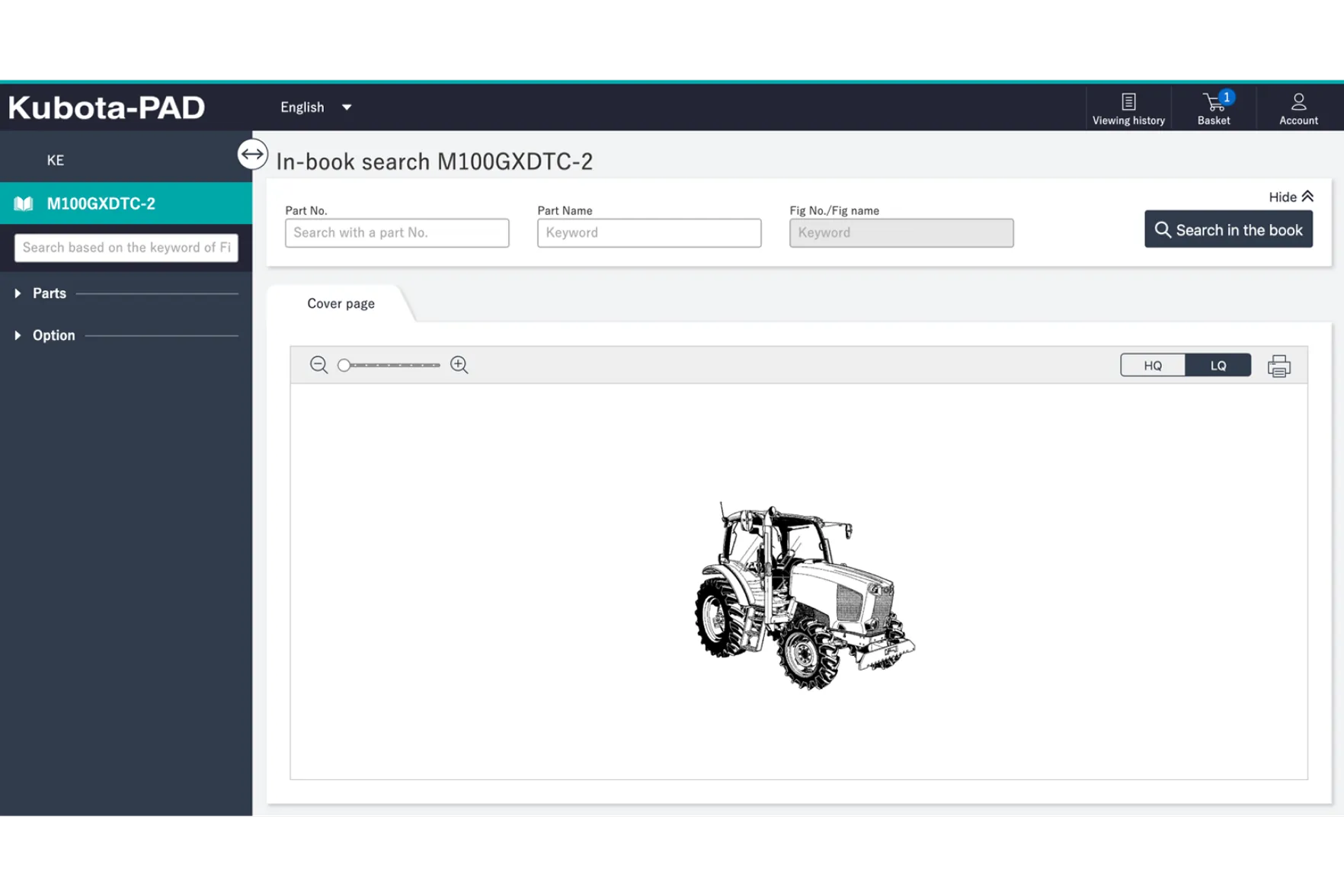
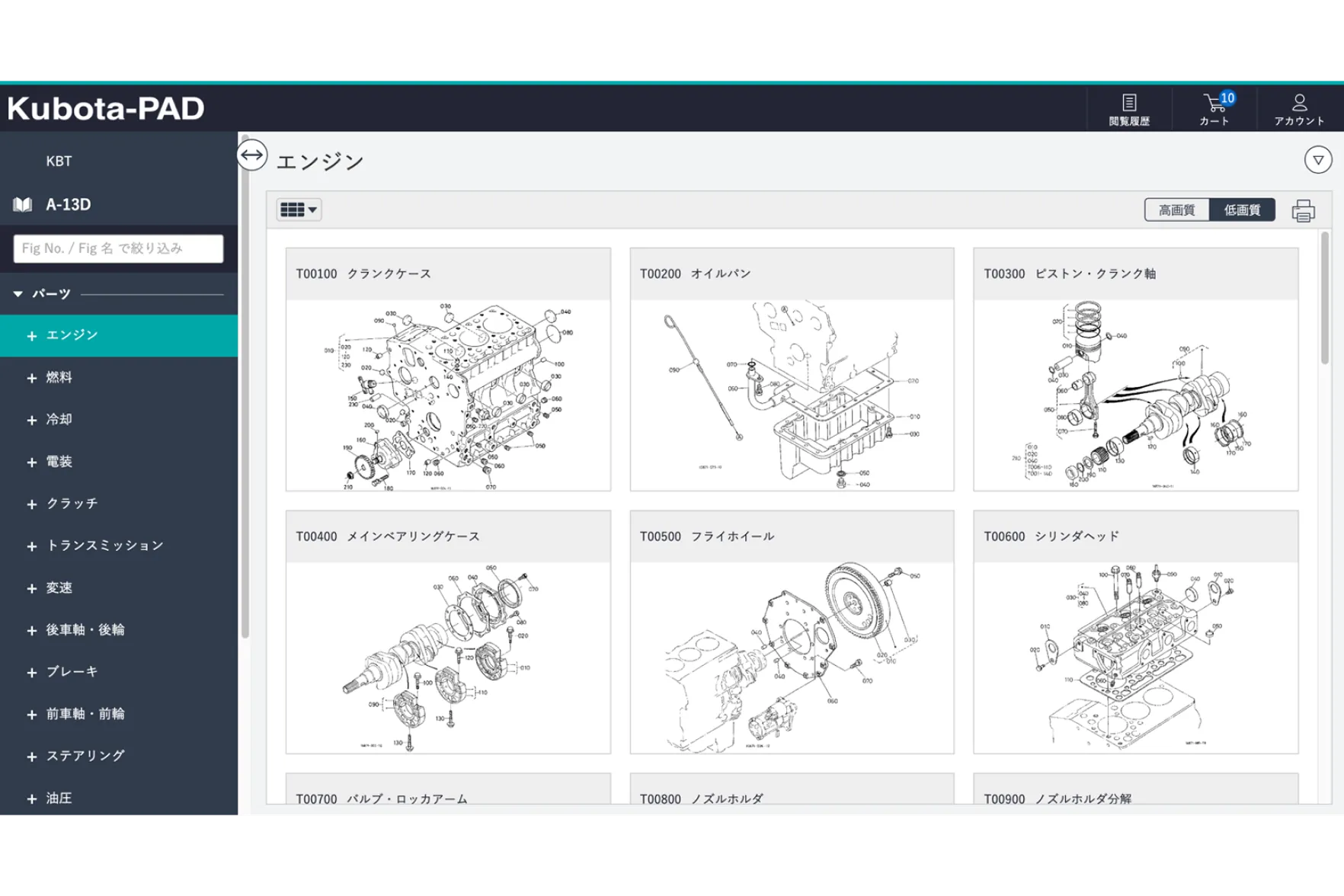
This system links to the core service parts management system and is used globally both inside and outside of the company. As a system intended for global use, there were three key requirements: user-friendly operation, high-speed responsiveness, and multi-device compatibility. Fenrir was responsible for the design and development of this system as part of a replacement for Kubota’s existing system.
One of the key goals was the ability to quickly identify required parts from among the hundreds of thousands of service parts used globally, and to browse related parts as smoothly as a native application. To achieve this, a Single Page Application (SPA) approach was adopted for the web application.
Additionally, a framework that allows for easy long-term maintenance (Angular) was adopted in order to regularly analyze how users operate the system and flexibly make improvements. Several prototypes were developed to test various hypotheses, resulting in an approximately 30% reduction in screen transitions compared to the existing system.
As a system intended for use at Kubota’s locations worldwide, multilingual support, high-speed responsiveness, the ability to flexibly adapt to changing market environments, and stable, easy-to-maintain operation were also important requirements. To meet these needs the “Kubota-PAD4.0” system was designed and developed with a focus on system scalability, and adopted Microsoft Azure as its cloud-based infrastructure. By leveraging Azure storage services and valet key pattern for efficient image distribution, implementing preloading and caching for content, thoroughly tuning SQL, and introducing a full-text search engine for rapid keyword searches of parts, various improvements were made for the new system, achieving approximately 40% display speed improvement compared to the existing system.
While retaining the familiar usability of the existing system, we thoroughly focused on every detail, such as positioning frequently used search features in easy-to-understand locations and making buttons intuitive to use, to ensure that even users with little experience could comfortably operate the system.
At the beginning of the project, it took a lot of time to examine the new system’s table structure due to the complexity of terms, rules, and data structures. We also had repeated discussions with the client regarding the use of Azure’s various services and the system’s architecture, which we believe allowed us to build the best possible system configuration. Collaborating and thinking together with the client fostered a sense of unity, enabling us to proactively propose various improvement ideas. The client told us, “When we gave you difficult requirements, instead of turning them down, you seemed happy to tackle them,” and “I wondered if easy requirements might bore you—maybe you’re the kind of people who thrive on tackling tough challenges.” As Fenrir, we’re pleased that our positive and proactive approach to meeting the client’s expectations through design and technology came through, and that we were able to work as a united team to meet those expectations.
Designing a UI to improve usability while maintaining the already established operation flow of the existing system, and accommodating unique specifications, was a high-level challenge. Thanks to cooperation with the engineering team, we were able to create mockups for front-end implementation early on, and discuss even the smallest movement details with the client. I believe this enabled us to achieve a UI design and interface that truly satisfied everyone involved.